

Walk into almost any kitchen and you’ll likely find a container of black pepper sitting quietly beside the salt. It is so common today that few people give it much thought.
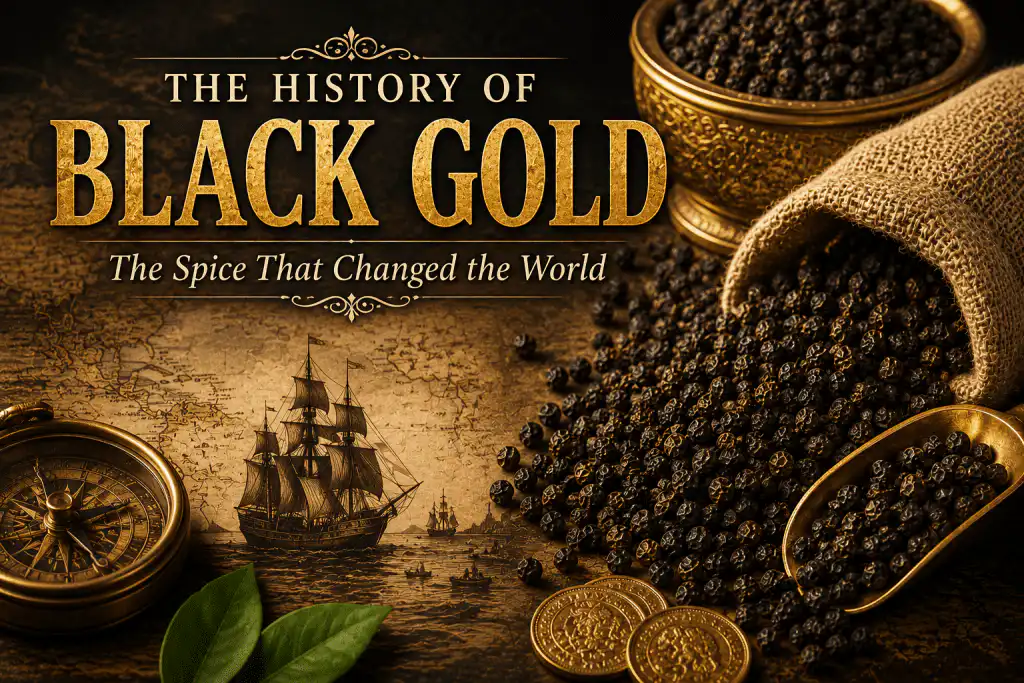
Yet for centuries, black pepper was one of the most valuable commodities on Earth. It traveled thousands of miles across dangerous trade routes, influenced global commerce, and became a symbol of wealth and status. In some places and periods of history, peppercorns were even accepted as payment for rents, taxes, and debts due to their extraordinary value.
What is now one of the most affordable spices in the grocery store was once known as “Black Gold.”
Where Does Black Pepper Come From?
Black pepper comes from the fruit of the pepper vine, Piper nigrum, a tropical climbing plant native to the Malabar Coast of southwestern India.
The vine produces clusters of small berries known as peppercorns. Depending on when they are harvested and how they are processed, these berries become the different varieties of pepper commonly found around the world.
- Green peppercorns are harvested while immature and preserved to maintain their color.
- Black peppercorns are harvested when nearly mature and then dried.
- White peppercorns are fully ripened berries that have had their outer layer removed.
- Red peppercorns are allowed to fully ripen on the vine before harvest.
Although they come from the same plant, each variety develops its own distinct flavor and culinary uses.
Why Is Black Pepper Black?
Most people never stop to ask why black pepper is black.
When peppercorns are harvested and dried, the outer skin undergoes natural enzymatic reactions and oxidation. As moisture is removed, the surface darkens and wrinkles, creating the familiar appearance of black peppercorns.
This drying process does more than change the color. It also helps develop the characteristic aroma and pungent flavor that black pepper is known for.
The Spice Trade and the Rise of Black Gold
Black pepper has been traded for thousands of years.
Ancient merchants transported pepper from India through networks connecting Asia, the Middle East, Africa, and Europe. Egyptian, Greek, and Roman civilizations all valued pepper, but demand grew dramatically during the Middle Ages.
By this time, pepper had become one of the most sought-after commodities in Europe. Because it had to travel long distances through multiple traders before reaching its destination, it was expensive and often reserved for those who could afford it.
The enormous demand for pepper helped establish trade routes that connected distant parts of the world. Merchants crossed deserts, navigated seas, and built trading networks largely because of the value placed on spices such as black pepper.
In many ways, the global appetite for pepper helped shape exploration, commerce, and international trade for centuries.
Pepper as a Symbol of Wealth
Today, a jar of pepper costs only a few dollars.
Historically, however, pepper was often viewed as a luxury item.
In parts of medieval Europe, peppercorns could be accepted as payment for rents, taxes, debts, and other obligations. Wealthy households frequently kept stores of pepper, not only for culinary purposes but also as a visible display of prosperity.
The term “peppercorn rent,” which still exists in legal language today, originated from the practice of using peppercorns as a symbolic payment when the spice itself held significant value.
More Than a Seasoning
Most people think of black pepper simply as a flavor enhancer.
Historically, it served a broader purpose.
Before refrigeration, many foods were preserved through salting, drying, smoking, and fermentation. These methods extended shelf life but often altered flavor and texture. Spices such as black pepper became valuable because they improved the taste of stored foods and added variety to meals during seasons when fresh ingredients were scarce.
Its bold flavor helped make preserved foods more enjoyable and contributed to its growing popularity throughout Europe and beyond.
Black Pepper in Traditional Herbal Practices
Long before modern supplements existed, herbs and spices played an important role in traditional wellness systems.
Black pepper was frequently valued for its warming and stimulating qualities.
Traditional herbalists often used black pepper to:
- Support healthy digestion
- Encourage appetite
- Promote circulation
- Warm the body during colder seasons
- Complement other herbs in herbal preparations
Because of its warming nature, black pepper was commonly included in foods, teas, broths, and herbal formulas intended to support digestive comfort and overall vitality.
What Makes Black Pepper Pungent?
Black pepper contains a naturally occurring compound known as piperine.
Piperine is largely responsible for the sharp, pungent sensation associated with black pepper. Unlike the heat from chili peppers, which comes from capsaicin, the characteristic bite of black pepper comes primarily from piperine interacting with sensory receptors in the mouth.
Black pepper also contains aromatic oils that contribute to its distinctive fragrance and flavor.
Together, these compounds have made black pepper one of the world’s most recognizable and widely used spices.
Why Freshly Ground Pepper Tastes Better
If you’ve ever compared freshly cracked pepper to pre-ground pepper, you’ve likely noticed a difference.
Whole peppercorns protect their aromatic oils inside the berry. Once pepper is ground, those volatile compounds begin to dissipate through exposure to air, light, and moisture.
As a result, freshly ground pepper typically provides a stronger aroma, richer flavor, and more complex taste than pepper that has been pre-ground and stored for extended periods.
For the best flavor, whole peppercorns should be stored in an airtight container away from direct sunlight and ground as needed.
From Ancient Trade Routes to Modern Kitchens
Few ingredients have traveled a journey as remarkable as black pepper.
For centuries, merchants crossed oceans and continents in pursuit of this small spice. It influenced trade networks, represented wealth, and became a staple in cuisines around the world.
Today, black pepper is one of the most accessible spices available, yet its history remains extraordinary.
The next time you sprinkle black pepper onto a meal, take a moment to appreciate the story behind it. What appears to be an ordinary seasoning was once among the most valuable substances in global trade—a reminder that even the simplest ingredients often have the most fascinating histories.