
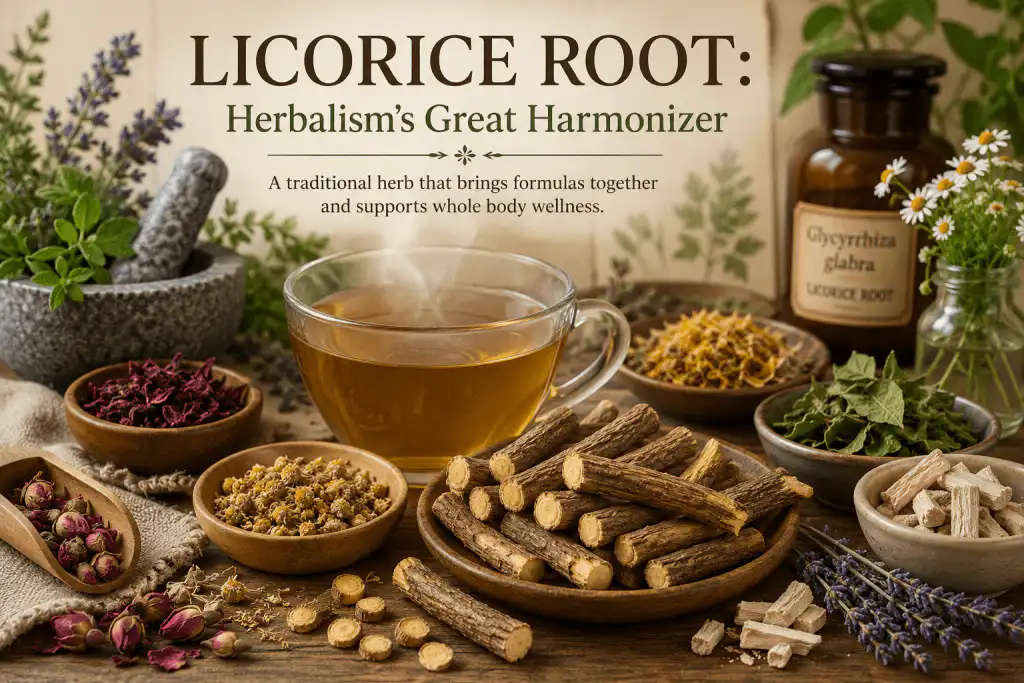
Licorice Root: One of Herbalism’s Great Harmonizers
Most people know licorice as a candy flavoring, but in traditional herbalism, licorice root has long been considered one of the most important herbs in the materia medica.
In fact, many herbalists view licorice as a “harmonizing herb”—a plant often added to formulas not only for its own traditional uses but because it helps bring the entire formula together.
Its naturally sweet flavor is only a small part of the story.
Why Herbalists Love Licorice Root
Licorice root occupies a unique place in traditional herbalism because it appears across many body systems.
Historically, it has been used in formulas intended to support:
- Respiratory wellness
- Digestive comfort
- Stress resilience
- Energy and vitality
- Throat support
- General restoration
Few herbs have such a broad reputation across so many traditions.
A Traditional Herb for Times of Stress
One reason licorice root became so valued is its long history of use during periods of physical and emotional strain.
Traditional herbal systems often viewed licorice as a nourishing herb that could help support the body’s ability to adapt during demanding times.
For this reason, it frequently appears alongside herbs such as ashwagandha, tulsi, and reishi in modern herbal practice.
Licorice Root and the Digestive System
Traditional herbalists also valued licorice for digestive wellness.
Historically, it was often included in herbal preparations intended to soothe and support the digestive tract.
Its naturally sweet nature made it especially useful in formulas designed for long-term use.
Sweetness with a Purpose
Licorice root is one of the sweetest herbs found in nature.
But herbalists didn’t simply use it because it tasted good.
In many traditional systems, the sweet flavor was associated with nourishment, moderation, and balance.
This may explain why licorice appears in so many classic formulas that have survived for centuries.
The Herb That Brings Formulas Together
Perhaps the most fascinating aspect of licorice root is that many herbalists view it as a botanical “team player.”
Instead of dominating a formula, it often works in the background.
Its role is frequently described as supporting, harmonizing, and complementing the actions of other herbs.
This is one reason it appears in countless traditional herbal formulas throughout the world.
A Note of Caution
Despite its long history of use, licorice root is not appropriate for everyone.
Individuals with high blood pressure, kidney disease, certain heart conditions, or those taking specific medications should seek professional guidance before using licorice root regularly.
Final Thoughts
Licorice root is far more than a sweet flavoring.
For thousands of years, herbal traditions around the world have valued it as a versatile, supportive, and harmonizing herb. Its ability to appear across so many traditional formulas is a testament to the respect it has earned among generations of herbalists.