
THE BODY ALREADY HAS THE SYSTEM
Your body already carries its own stem-cell reserve. The question is what causes those cells to move—and why that matters.
When most people hear the words stem cells, they think of laboratories, injections, medical procedures, or something that has to be put into the body.
But that is only one part of the stem-cell conversation.
Your body already has stem cells.
Right now.
They live within specialized areas throughout the body—including the bone marrow, adipose tissue, skin and hair follicles, intestinal lining, skeletal muscle, and certain regions of the brain—where different stem-cell populations help maintain, renew, and repair the tissues around them.
That was what pulled me into this research in the first place.
Because once you understand that the body already carries its own reserve, the question changes.
It is no longer only:
“Where can stem cells come from?”
It becomes:
What causes the stem cells already inside the body to leave their reserve and enter circulation?
That process is called stem cell mobilization.
And once I started understanding what mobilization actually meant, I wanted to know everything I could about it.
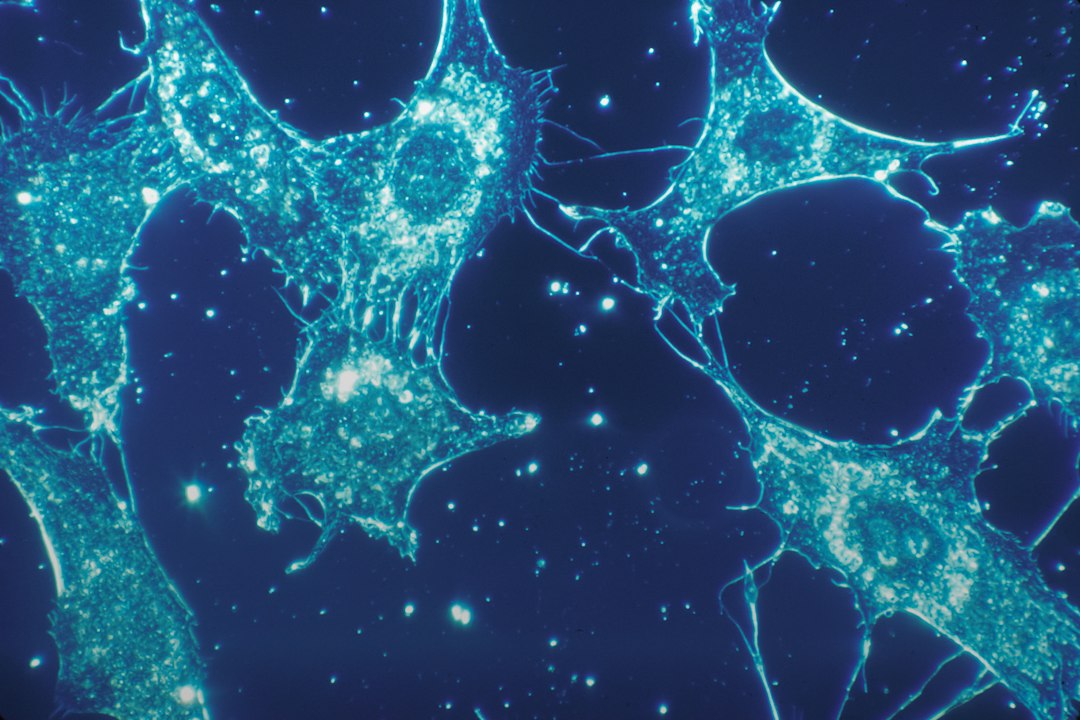
Microscopic human connective tissue cells. National Cancer Institute / Unsplash.
The Body Can Release Its Own Stem Cells Into the Bloodstream
Stem and progenitor cells do not simply float through the bloodstream at the same level all day long.
Many reside within specialized environments, particularly within the bone marrow.
But the body can respond to certain signals by releasing some of those cells into circulation.
That movement from their reserve into the bloodstream is what researchers mean when they talk about mobilization.
Why does that matter?
Because the bloodstream gives these cells access to the larger body.
The body uses circulation as transportation.
Oxygen travels through it. Nutrients travel through it. Hormones travel through it. Immune cells travel through it. And circulating stem and progenitor cells travel through it too.
Once I understood that, stem-cell support stopped sounding like some distant futuristic concept.
This is a biological process already taking place inside us.
The body already has the system. The real question is how that system can be supported.
Researchers Can Actually Watch This Process Happen
This is the part that made me stop and look deeper.
Researchers do not have to simply guess whether certain stem-cell populations are entering circulation.
They can draw blood and measure them.
Different populations of stem and progenitor cells carry identifiable markers on their surface. You may see names such as CD34 or CD133 in stem-cell research.
You do not need to memorize those names.
What matters is what they allow researchers to do.
They can take a baseline blood sample, introduce an intervention, draw blood again, and determine whether the number of particular circulating cell populations has changed.
Why does that matter?
Because now we are no longer talking only about theory.
There is something measurable happening inside the bloodstream.
And that is exactly what researchers did with one botanical that eventually became extremely important to my work.
Cellular research is measurable—not simply theoretical. Logan Gutierrez / Unsplash.
One Botanical Made Me Look at This Entire Subject Differently
I am intentionally not naming this botanical here yet.
What matters right now is what researchers observed.
In a published human study, participants consumed a traditionally prepared botanical and researchers measured specific stem-cell populations in their blood before and afterward.
Within approximately two hours, researchers reported increases of up to 53% in two measured circulating stem-cell populations.
Those increases remained measurable beyond three hours.
That immediately caught my attention.
But I did not stop there.
Because when something becomes important enough for me to eventually include within a protocol, I want to know far more than one headline.
I wanted to know:
Was it tested again? Were different amounts examined? Were different preparations examined? Were researchers looking at only one type of circulating cell? How long did the response last? What exactly were they measuring?
And the deeper I went, the more interesting the research became.
Why does this matter?
Because researchers were not simply describing this plant with traditional words like “restorative” or “rejuvenating.”
They were drawing blood.
They were measuring identifiable cell populations.
And they were watching those populations change.
That is a completely different level of information.
There Was More Human Testing Than One Experiment
The story did not end with the original published study.
Separate human testing examined additional preparations and different amounts of the botanical.
Researchers looked at multiple circulating stem and progenitor-cell populations and followed their changes at different time points after consumption.
Different preparations were compared. Different doses were examined. Several identifiable populations were measured.
And once again, researchers documented changes in circulating cells.
Some of the pooled human data showed roughly a 30% increase in circulating CD34+ cells at two hours, while another measured population showed an increase of approximately 45% at that same time point.
Other populations responded differently.
And that is important.
Why does this matter?
Because biology is rarely one-dimensional.
There is not just one type of stem or progenitor cell doing one job.
Researchers were seeing changes across multiple identifiable populations.
For me, that meant this wasn’t something I could dismiss as another interesting herb study and move on from.
I wanted to understand what the body was doing.
And more importantly:
Why would the body have a system capable of releasing these cells into circulation in the first place?
Mobilization Exists for a Reason
The body does not maintain stem and progenitor cells simply for them to sit unused.
They participate in normal processes involving renewal, blood formation, vascular function, adaptation, and repair.
When certain populations enter circulation, they become part of a much larger communication system taking place throughout the body.
There are signals. There are receptors. There are tissues calling for different forms of support. There are cells responding to their environment.
The human body is constantly communicating internally in ways we rarely think about.
Why does this matter?
Because mobilization is not the end of the story.
It is the beginning.
If cells are entering circulation, then we also have to think about the environment they are entering.
What kind of internal terrain are they moving through? What resources does the body have available? How is the body responding to stress? How well is circulation functioning? What is happening at the cellular level? What signals are being produced throughout the body?
Those questions became just as important to me as mobilization itself.
And that is where the idea for the Stem Cell Support Protocol became much bigger.
I Did Not Want to Build Something Around One Mechanism
It would have been easy to find one botanical associated with stem-cell mobilization and stop there.
That wasn’t enough for me.
The body does not work that way.
One system does not operate independently of everything surrounding it.
Stem cells exist within an environment. They interact with circulation. They respond to signals. Cells require energy. The body has to manage oxidative activity. The nervous system and stress response communicate with the rest of physiology. Nutrition supplies the materials the body uses every single day.
Everything connects.
Why does this matter?
Because supporting one biological process while ignoring everything surrounding it never made sense to me.
I wanted the protocol to address the bigger biological picture.
That changed how I selected every component.
The question was never:
“How many impressive ingredients can I put together?”
The question was:
“What role does this serve inside the complete system?”
Every part needed a reason for being there.
The Protocol Was Built in Layers for a Reason
The Lael Herbal Home Stem Cell Support Protocol is not a random collection of powders, herbs, or supplements placed together because each one sounds healthy.
It was designed as a system.
There is a mobilization component.
There are components selected to support the internal environment surrounding cellular activity.
There is support for resilience and the body’s response to stress.
There is support for nourishment.
There is support for the wider cellular environment.
And there are pieces that connect those purposes together.
Why does this matter?
Because the protocol is intended to work as a whole.
That is also why I am not publishing its ingredients one by one.
If I reveal a piece without explaining the entire structure surrounding it, someone could easily look at one ingredient and assume:
“Oh, that’s the protocol.”
It isn’t.
No single ingredient is the protocol.
The relationship between the different layers is the protocol.
And I am protecting that formulation until I am ready to reveal it properly.
Traditional Knowledge Made This Even More Interesting
One of the things I love most about herbalism is discovering places where traditional knowledge and modern measurement suddenly meet.
People were using the botanical at the center of this story long before anyone had a flow cytometer available to count circulating stem cells.
They did not call what they were seeing “CD34+ mobilization.”
They did not describe receptors, signaling molecules, or cell markers.
They observed the human body. They observed plants. They prepared them in particular ways. And they passed knowledge forward.
Generations later, researchers were able to take blood samples and measure something that those traditional practitioners could never have measured themselves.
Why does this matter?
Because modern technology can sometimes help us see a mechanism underneath something people have observed for generations.
That doesn’t erase traditional knowledge.
It gives us another window into it.
And this particular window opened an entire area of research for me.
Then I Started Asking a Bigger Question
Once I understood the mobilization research, I could not look at this as merely:
“Here is a plant that increases circulating stem cells.”
My question became much bigger.
What if we supported the process AND supported the body those cells are moving into?
That is the question behind the protocol.
Not one ingredient. Not one pathway. Not one isolated compound.
A coordinated approach built around the body’s own biological systems.
That is what I have been developing.
And every time I dug deeper into the research, another layer of the protocol began to make sense.
The Body Already Has the Machinery
This may be the part I want people to understand most.
Your body was not created without systems for renewal.
It already contains stem cells.
It already has mechanisms for releasing certain populations into circulation.
It already has communication systems capable of directing enormously complex biological activity without you consciously controlling any of it.
The body is not passive.
It is constantly responding. Constantly adapting. Constantly communicating. Constantly rebuilding.
And when I began understanding just how sophisticated those systems are, I stopped asking only how we could introduce something new into the body.
I became far more interested in another question:
How can we support what the body already knows how to do?
That question became the foundation of the Lael Herbal Home Stem Cell Support Protocol.
And what I have shared here is only the beginning of that story.
🌿 Continue Into the Stem Cell Support Protocol
If you want to see why I built this protocol, what I am working to support inside the body, and why I chose a multi-layered approach rather than relying on one isolated mechanism, continue to the Stem Cell Support Protocol page.
Lael Herbal Home provides educational information intended to support informed wellness choices. This content is not intended to diagnose, treat, cure, or prevent disease.