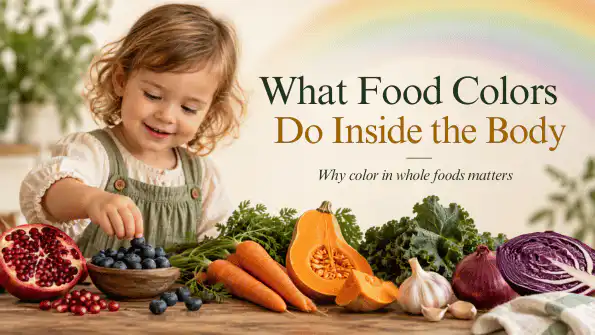
Deep red pomegranates. Dark purple berries. Bright orange squash. Rich green herbs. White garlic. Nearly black rice.
Walk through the produce section and really look at what is in front of you. We see these colors every day, but most of us rarely stop to ask a very simple question: Why are they there?
The color of a plant is not simply decoration. Plants create pigments because those pigments help them live. Chlorophyll allows plants to capture light for photosynthesis. Carotenoids help plants manage light and protect their tissues. Anthocyanins can help protect against environmental stress, while the brilliant colors of fruits and flowers can attract the animals and insects involved in pollination and seed dispersal.
So when we look at the color of a plant, we are seeing part of its chemistry. Then we eat it, and those compounds that served the plant enter an entirely different environment—the human body.
That is where understanding what food colors mean becomes much more interesting than simply saying, “Eat the rainbow.”
Traditional systems of medicine also paid close attention to food, plants, colors, tastes and patterns in nature. But they did not all organize those observations in the same way. Understanding those differences gives us a much deeper starting point.
Why Traditional Chinese Medicine Connected Color, Organs and the Elements
When Traditional Chinese Medicine connects green with the Liver, red with the Heart, yellow with the Spleen, white with the Lungs and dark colors with the Kidneys, these relationships are part of a much larger framework called Wu Xing.
Wu Xing is commonly translated as the Five Elements, although Five Phases may better describe what the system is actually expressing. Wood, Fire, Earth, Metal and Water are not simply five physical substances. They describe patterns of change.
Wood grows and expands. Fire rises, heats and expresses outward. Earth receives, transforms and nourishes. Metal contracts, separates and creates structure. Water descends, stores and moves toward depth.
Traditional Chinese medicine applied these same patterns to the body because the body was not viewed as separate from nature. The seasons, temperature, taste, emotion, movement and physiology were understood as different expressions of larger patterns. That is why each phase came to include a season, organ system, color, taste, emotion and tissue.
Wood, Spring, Green and the Liver
Look at what happens in spring. After the stillness of winter, plants begin moving again. Shoots push through the soil, branches extend, leaves unfold, and everything begins moving upward and outward. That is the Wood pattern.
Green became associated with Wood because green growth is one of the clearest visible signs of spring. The Liver belongs to Wood because Traditional Chinese Medicine describes the Liver as helping maintain the smooth movement of Qi throughout the body.
Healthy Wood moves, bends, adjusts and grows without becoming stuck. Think about a young tree. Flexibility allows it to move with pressure rather than break against it. This helps explain why Wood is also traditionally associated with the tendons and sinews, as well as with anger and frustration. Anger rises, while frustration can feel blocked. Within the traditional framework, both can reflect the same theme of movement—either becoming excessive or becoming constrained.
Fire, Summer, Red and the Heart
Spring growth eventually reaches the fullness of summer. Days are longer, heat increases, plants flower and nature is at its most outward and active. That is Fire.
Fire represents warmth, expansion, activity and expression. Its traditional color is red. The Heart belongs to Fire because Chinese medicine associates the Heart with the blood and vessels and with Shen, often translated as the mind or spirit. Its corresponding emotion is joy, and once again these relationships follow a pattern: joy is expressive, summer is expansive, fire radiates outward and blood circulates.
Earth, Yellow and the Spleen
Earth has a different role. Earth receives. Seeds enter it. Plants draw nourishment from it, and food grows from it. The Earth phase therefore became associated with nourishment and transformation.
Traditional Chinese Medicine places the Spleen and Stomach within this phase because their traditional role is to receive food, transform it and make nourishment available to the body. Yellow became the corresponding color, traditionally connected with soil, grains and harvest. The sweet taste also belongs to Earth—not meaning refined sugar, but the naturally nourishing sweetness found in foods such as grains, root vegetables and squashes.
Metal, Autumn, White and the Lungs
By autumn, nature begins pulling inward. Leaves fall, growth slows and plants release what they no longer need. The expansive movement of spring and summer begins to contract. That is the Metal phase.
Metal represents structure, boundaries, contraction and separation. The Lungs belong to Metal. Traditional Chinese medicine connects the Lungs with respiration, the movement of Qi and the skin—the boundary between the body and the outside environment. The Large Intestine is paired with the Lungs, strengthening the traditional theme of receiving what is useful and releasing what is no longer needed. The corresponding emotion is grief, and autumn itself reflects a similar process of loss, release and drawing inward.
Water, Winter, Black and the Kidneys
Winter brings nature inward even further. Very little may appear to be happening above the ground, but life has not disappeared. Roots remain alive, seeds wait and resources are conserved. The potential for future growth is being stored. That is Water.
Water naturally moves downward and toward depth. Traditional Chinese Medicine places the Kidneys within this phase because they are associated with Essence, reproduction, development, bones and the body’s deepest reserves. Dark blue and black became associated with Water. Its season is winter, and its emotional correspondence is fear. The larger pattern is one of depth, conservation, storage and potential.
Why Seasons, Tastes and Emotions Matter
Once we understand the Five Phases this way, the additional relationships make much more sense. Traditional Chinese Medicine was not collecting unrelated facts. It was looking for patterns that repeated themselves throughout nature and the body.
Wood expresses growth and movement, so spring, green, the Liver, sour taste and anger belong to that family of relationships. Fire expresses heat and outward activity, connecting summer, red, the Heart, bitter taste and joy. Earth expresses nourishment and transformation, connecting yellow, the Spleen and the sweet taste. Metal expresses contraction and release, connecting autumn, white, the Lungs, pungency and grief. Water expresses storage and depth, connecting winter, dark colors, the Kidneys, salty taste and fear.
The system is asking a much larger question: What pattern is appearing here?
That is far more meaningful than reducing Chinese medicine to “green foods are for the liver.” But Chinese medicine was not the only traditional system looking at the relationship between food, nature and the body. Ayurveda asked a different question.
Why Ayurveda Chose a Different Way of Understanding Food
Ayurveda also sees the human body as part of nature and recognizes five elements: Space, Air, Fire, Water and Earth. But its approach to food developed differently.
Rather than creating a primary dietary framework around color and organ correspondences, Ayurveda focused heavily on how a substance behaves once it enters a particular person. It asks what the food tastes like, whether it is heavy or light, dry or oily, warming or cooling, how easily the person digests it, what happens after digestion, what season it is, and what the person’s constitution and current imbalance are.
This is why Ayurvedic pharmacology developed concepts such as rasa, guna, virya, vipaka and prabhava. Rasa refers to taste. Guna describes qualities. Virya describes potency, often including whether something is heating or cooling. Vipaka describes what happens after digestion. Prabhava refers to a particular action that cannot be fully explained by the other properties.
Taste became especially useful because it can be perceived immediately. The tongue begins gathering information the moment food enters the mouth, while some deeper effects only become apparent later through digestion and observation. Ayurveda therefore did not need color to become its central dietary map; it already had a detailed system for understanding the qualities of food and how those qualities interact with the person receiving them.
Where Western Herbalism Fits Into This
Western herbal traditions also paid attention to the visible characteristics of plants. One historical idea became known as the Doctrine of Signatures.
The belief was that features of a plant could sometimes offer clues about its traditional use. Color mattered. Shape mattered. Where the plant grew mattered. The way it behaved could matter. Red plants or red sap were sometimes associated with blood. Yellow plants were sometimes connected with bile or conditions involving yellow coloration. Plants resembling particular body parts were sometimes associated with those areas of the body.
For some herbalists, there was also a spiritual understanding behind this. Nature was seen as ordered rather than meaningless, and visible features within creation could be interpreted as signs placed there by G-d.
But Western herbalism never relied on appearance alone. Herbalists also learned through taste, preparation, repeated observation and experience. A bitter herb behaved differently from a sweet, moistening herb. An aromatic plant behaved differently from an astringent one. Roots, leaves, flowers, berries and bark required different preparations and offered different qualities.
Across all three traditions, humans have long used the senses to understand plants. They looked, tasted, smelled, watched how plants grew and observed what happened after those plants entered the body. Today, we can add another layer by looking more closely at both the chemistry behind the colors and what those compounds do after we consume them.
What the Colors in Our Food Are Showing Us
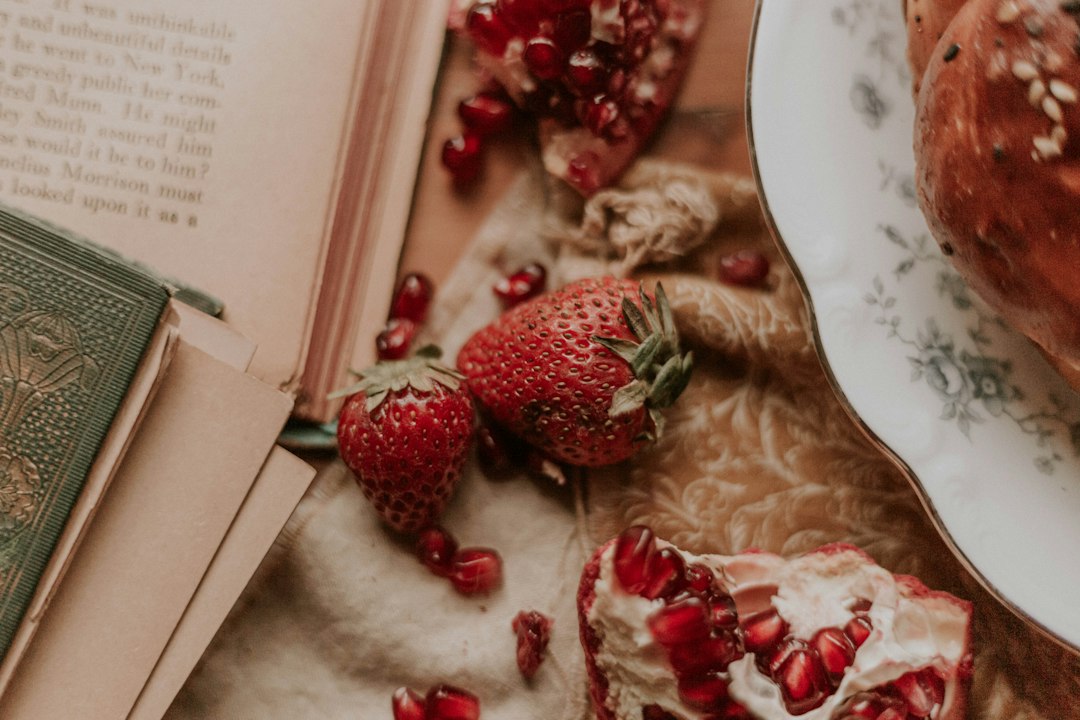
Photo: Benigno Hoyuela / Unsplash
Red Foods: Lycopene, Betalains, Anthocyanins and Polyphenols
Tomatoes, beets, strawberries and pomegranates may all appear red, but they are not red for the same reason. Tomatoes contain large amounts of the carotenoid pigment lycopene. Beets get much of their red color from betalains. Strawberries and many other berries contain anthocyanins along with numerous other polyphenols. Pomegranates bring together anthocyanins with a particularly rich mixture of polyphenols, including ellagitannins.
Lycopene participates in the body’s redox balance and can help protect lipids and cellular structures from excessive oxidative damage. Betalains interact with oxidative balance and inflammatory pathways. Anthocyanins and their metabolites interact with blood vessel function as well as glucose and lipid pathways.
Pomegranate adds another fascinating layer. Some of its ellagitannins are transformed by gut microorganisms into compounds called urolithins. Different people may produce different amounts depending on the composition of their microbiome. Part of the effect therefore depends on the plant, part on digestion, and part on the person eating it.
Orange and Yellow: Carotenoids, Vitamin A and the Eyes
Carrots, pumpkin, squash and sweet potatoes contain large amounts of carotenoids. Inside the plant, carotenoids help manage light. Inside the human body, some members of that same chemical family take on entirely different roles.
Beta-carotene is a provitamin A carotenoid because the body can convert it into vitamin A. Vitamin A becomes involved in vision, immune function, reproduction, growth and tissue maintenance. Lutein and zeaxanthin are different: they become concentrated in the macula of the human eye, where they help form macular pigment and participate in antioxidant protection of retinal tissue.
Turmeric is also intensely yellow, but its color comes largely from curcuminoids, especially curcumin, rather than carotenoids. A carrot and turmeric may look as though they belong together because they are yellow-orange, but chemically they are doing very different things.
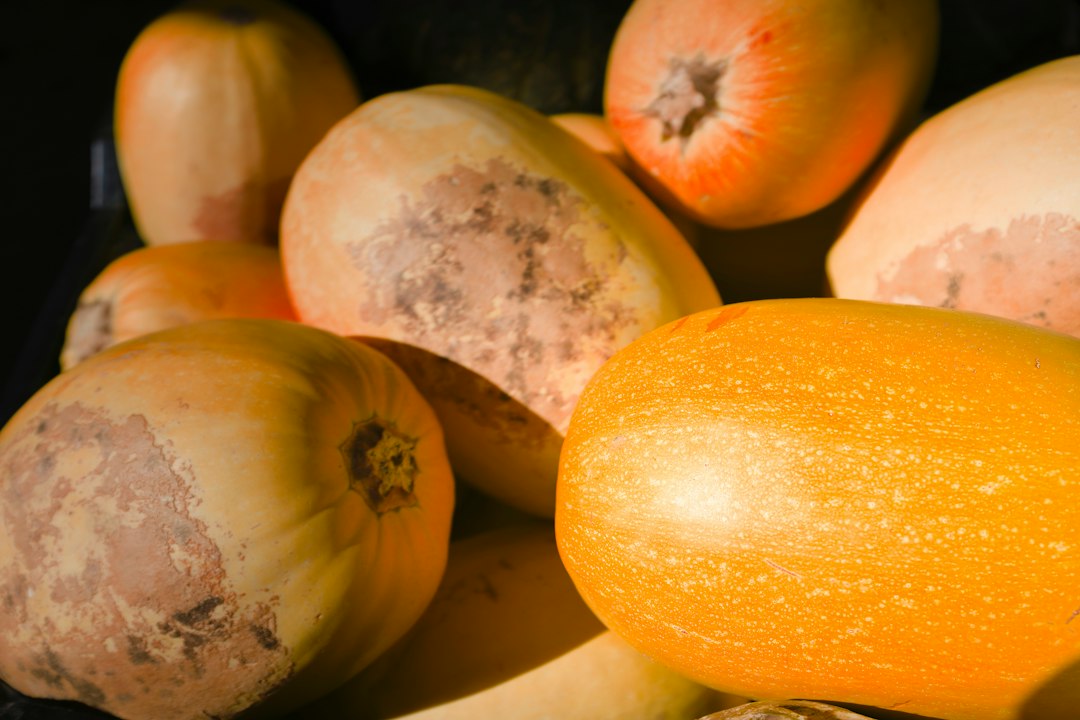
Photo: Eric Prouzet / Unsplash
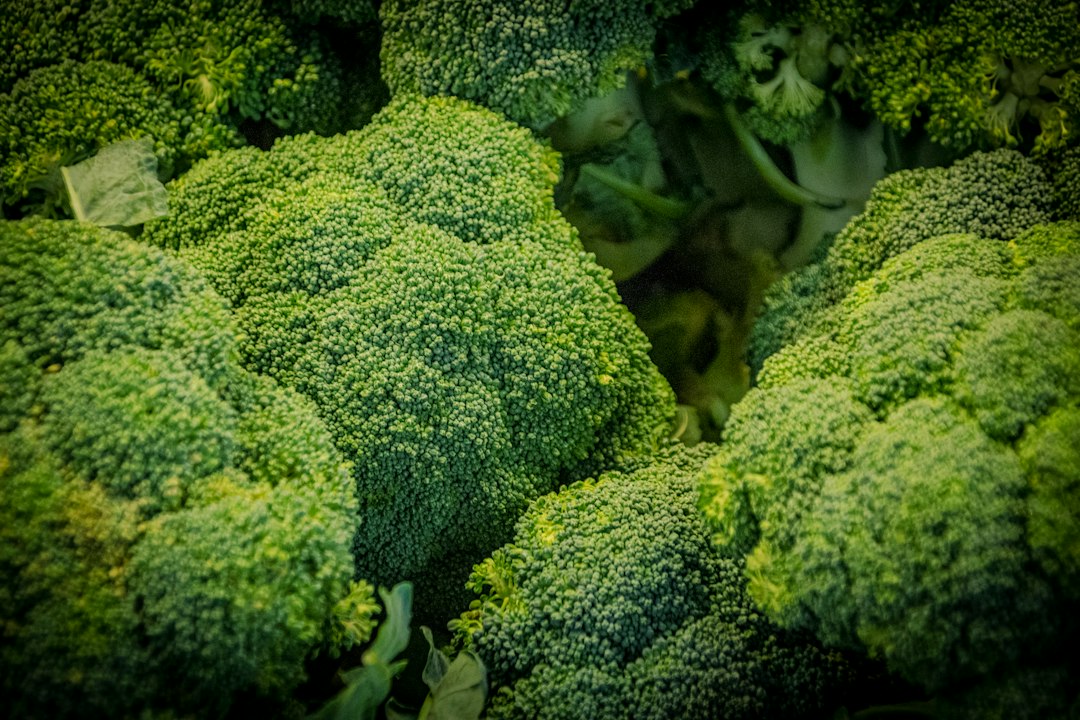
Photo: Waldemar Brandt / Unsplash
Green: Much More Than Chlorophyll
The green color of plants comes primarily from chlorophyll. Chlorophyll captures light energy that the plant uses during photosynthesis, making it essential to the plant.
Green foods are valuable because they contain an entire matrix of compounds beyond the pigment we can see. A green leaf may contain carotenoids such as lutein and zeaxanthin underneath the chlorophyll. Leafy greens can also provide folate, magnesium and many different polyphenols.
Cruciferous green vegetables such as broccoli and kale bring another family of compounds entirely: glucosinolates. When these vegetables are chopped or chewed, glucosinolates can be converted into biologically active compounds such as isothiocyanates, which interact with cellular defense pathways involved in responding to oxidative and chemical stress.
Blue and Purple: Anthocyanins and the Blood Vessels
Blueberries, blackberries, purple cabbage, dark grapes, purple carrots and purple sweet potatoes often contain large amounts of anthocyanins. The same pigment family can appear red, purple or blue depending partly on its chemical environment.
Once these compounds are consumed, they are broken down and transformed into metabolites that interact with vascular and metabolic pathways. Anthocyanins are particularly interesting because of their relationship with the endothelium, the thin cellular lining inside the blood vessels. That lining helps regulate how vessels widen and contract, how substances move between blood and tissues and how inflammatory signals are handled.
Photo: Moniek van Rosse / Unsplash
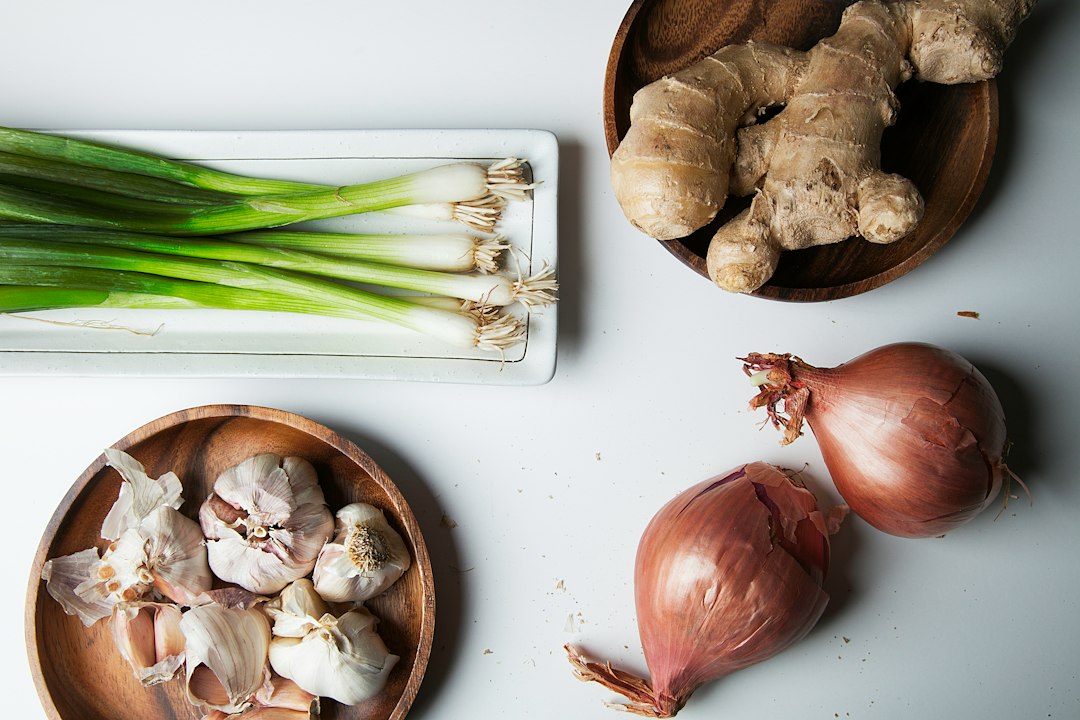
Photo: Nanxi Wei / Unsplash
White Foods: Sulfur Chemistry We Cannot See
Garlic, onions and cauliflower immediately challenge the idea that brightly colored foods must be more biologically active.
Inside an intact garlic clove, certain compounds are stored separately. When the clove is crushed or chopped, plant cells rupture. The enzyme alliinase then comes into contact with alliin, leading to the formation of allicin and a cascade of other organosulfur compounds. That chemical reaction is part of the reason freshly crushed garlic suddenly develops such a powerful smell.
Once consumed, those sulfur compounds interact with several systems in the body, including antioxidant defenses, inflammatory signaling, vascular function, platelet activity and microbial balance. Cauliflower provides another example: even though it is white, it belongs to the cruciferous family and contains glucosinolates.
Black Foods: Often Deep Pigments Rather Than a Separate Category
Black rice, black beans and dark berries may look black because their pigments are so concentrated that our eyes no longer distinguish the underlying purple or red. Cook black rice and watch the water—purple emerges.
In foods such as black rice and very dark berries, much of that color comes from concentrated anthocyanins. But not every black food owes its value to anthocyanins. Black sesame, black beans and black rice are very different foods. Their fats, fibers, minerals, proteins and non-pigment compounds add entirely different layers. Traditional Chinese food therapy groups dark foods within the Water phase, but nutritionally, “black food” is not one chemical category.
What Happens After We Eat These Plant Compounds?
A plant does not enter the body and remain unchanged. Digestion begins transforming it almost immediately. We chew, plant tissues break open and saliva mixes with food. The stomach introduces a different chemical environment, digestive enzymes begin breaking larger molecules apart, and bile becomes involved farther along in digestion.
The intestinal microbiome then encounters compounds that human digestive enzymes may not completely handle on their own. Some are absorbed, some are transformed and some continue through the digestive tract. So the food that enters the mouth and the substances eventually reaching the bloodstream are not always identical.
Why Fat Can Change Absorption
Carotenoids are fat-soluble, which means dietary fat can help them become incorporated into the structures the digestive system uses to absorb them. This is one reason eating carotenoid-rich vegetables completely plain is not always the same as eating them with some natural fat.
Tomatoes provide another example. Cooking changes the physical structure of tomato tissue, while the presence of fat can influence how accessible lycopene becomes during digestion. So “raw is always better” is too simple. Sometimes raw preserves something. Sometimes heat releases something. Sometimes chopping triggers a reaction. Sometimes excessive heat destroys something.
The important question is not whether one preparation method is universally superior. It is what that particular preparation does to that particular food.
Why Breaking a Plant Open Matters
Garlic shows this beautifully. Its chemistry changes when we damage the cells. Chewing, crushing or chopping allows compounds that were previously separated to interact, which means the preparation itself becomes part of the food’s chemistry.
This is one reason traditional food preparation deserves more respect. Soaking, fermenting, grinding, crushing, drying, simmering and cooking are not merely ways of making food easier to eat. They can change what is present and what becomes available.
The Microbiome Adds Another Layer
Our intestinal microorganisms transform many of the compounds reaching them. Pomegranate is one example, but it is far from the only one. Some plant compounds are poorly absorbed in their original form and become biologically different only after intestinal microorganisms break them down.
That means digestion is not simply something the stomach does. It is an entire process involving the food, digestive secretions, enzymes, intestinal microbes and the person eating it. Two people can therefore consume the same plant without necessarily processing every compound in exactly the same way.
And this brings us right back to something Ayurveda has emphasized for centuries: the food matters, but so does the person receiving it.
Why the Same Food Is Not the Same Experience for Everyone
Once we understand digestion this way, traditional individualized nutrition begins to make more sense. A child is not the same as an elderly person. Someone with strong digestion does not necessarily handle food the same way as someone whose digestion is weak. Winter is not summer. A raw food and a cooked version of that food may not be experienced the same way, and a food eaten by itself may behave differently within an entire meal.
This is why traditional systems were rarely built around a universal list of “good foods” and “bad foods.” They paid attention to relationships: food, person, season, preparation, digestion and balance.
So Why Eat Many Colors?
Because different colors usually lead us toward different plants, and different plants expose us to different chemistry. One plant may provide carotenoids that the body can convert into vitamin A. Another may provide anthocyanins that interact with vascular and metabolic signaling. Another brings sulfur compounds that activate cellular defense systems. Another provides polyphenols that our intestinal microbes transform into completely new metabolites.
Then there are the compounds we rarely talk about at all—fibers, minerals, aromatic compounds, bitter compounds, organic acids and thousands of other plant constituents.
The benefit is not that you checked red, yellow, green and purple off a chart. The benefit is botanical diversity.
A plate made primarily from refined beige foods contains far less plant diversity than a meal filled with greens, herbs, onions, garlic, squash, beans, seeds, berries and pomegranate. The visible diversity on the plate reflects a much larger diversity we cannot see.
And this is where traditional medicine and holistic nutrition begin to meet. Traditional Chinese Medicine looks at patterns and balance. Ayurveda looks at qualities, digestion and constitution. Western herbalism considers the plant, its taste, preparation and actions. Modern nutritional chemistry helps us see how different plant compounds interact with human physiology.
Eat the Rainbow—But Understand What You Are Really Eating
So yes, eat the pomegranate, the squash and the bitter greens. Use fresh herbs. Crush the garlic. Enjoy berries, beans, seeds, roots and vegetables. Bring color onto the plate.
But do not do it simply because an infographic told you that red belongs to your heart or purple belongs to your brain. Look deeper.
Those colors exist because plants are alive. They capture light, protect themselves, reproduce and respond to their environment. They create pigments, aromas, tastes and textures as part of their own survival. Then we eat those plants.
Some pigments are converted into vitamins. Some accumulate in particular tissues. Some influence vascular signaling. Some activate cellular defense systems. Some are transformed by our microbiome into completely different compounds. The plant’s chemistry becomes part of a conversation with our own biology.
Traditional cultures observed those relationships and created different systems to make sense of them. Chinese medicine looked for repeating patterns between the body and nature. Ayurveda examined the qualities of food and what happened during and after digestion. Western herbalists studied taste, preparation, action and the visible characteristics of plants. Today, plant chemistry gives us yet another way of understanding what those colors represent.
Food is not just fuel.
It is not merely protein, carbohydrates, fat and a vitamin number on the back of a package. It came from something living. And when G-d created plants in this extraordinary range of colors, tastes, textures and aromas, He did not create isolated nutrients. He created whole foods. And that is how I believe we should learn to see them.
Want to better understand which foods, herbs and daily habits may support your individual needs?
A Whole-Person Consultation with Lael Herbal Home looks beyond isolated symptoms and considers nutrition, herbs, lifestyle, digestion and the patterns affecting the body as a whole.
Continue reading: Bee Pollen: Tiny Granules, Powerful Whole-Food Nutrition
This article is for educational purposes and reflects traditional herbal, holistic nutrition and traditional medicine perspectives.