
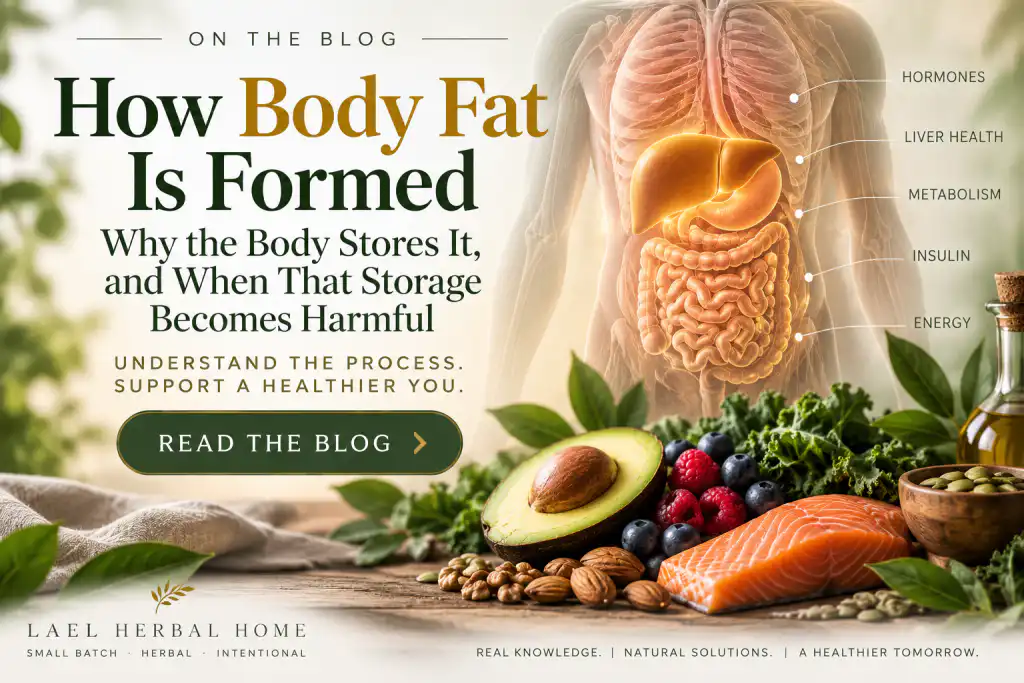
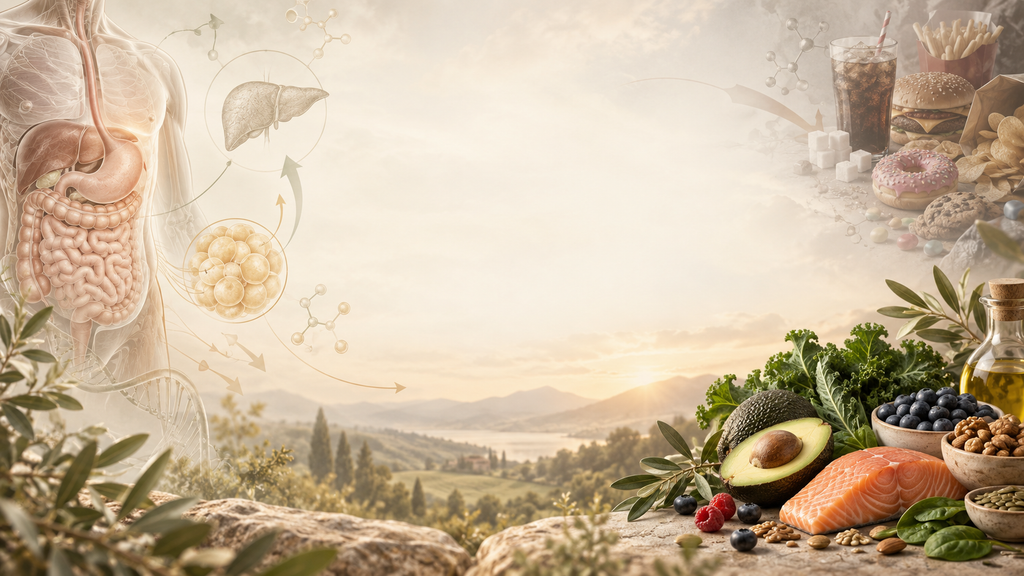
Body fat did not appear in the human body by mistake.
The Creator designed the body with the ability to store energy because we are not eating every second of every day. Our heart, brain, liver, muscles, kidneys, hormones, immune system and every other part of the body require energy around the clock. We eat, the body takes what it needs, and some of what is left can be stored so it is available later.
That storage system is necessary.
But there is a very important difference between the body storing fat the way it was designed to and the body beginning to accumulate excessive fat in places where it can interfere with normal function.
And to understand that difference, we first need to understand something most people were never really taught:
How does the food we eat actually become body fat?
Your Body Has to Decide What to Do With Everything You Eat
Every time we eat, the body has work to do. Food is broken down into smaller pieces that can be absorbed and used.
Carbohydrates are broken down mostly into sugars such as glucose. Protein is broken down into amino acids. Dietary fats are broken down into fatty acids and other fat components.
Those nutrients then enter circulation and the body has to decide what to do with them.
Some will be used immediately. Some will be used to build and repair tissue. Some will replenish stored fuel. And some may be stored for later.
That is where body-fat formation begins.
The body is constantly deciding:
Do I need this energy right now, or should I save it?
Why the Body Stores Energy as Fat
The body has more than one way to store energy.
Glucose can be stored as glycogen in the liver and muscles. Think of glycogen as short-term fuel storage.
Muscles can pull from their glycogen when they need energy, especially during activity. The liver can also help maintain blood glucose between meals by using its glycogen stores.
But glycogen storage is limited.
Fat is different.
Fat is an extremely efficient way to store a large amount of energy in a relatively small amount of space.
The body packages much of this stored fat in the form of triglycerides inside fat cells, which are called adipocytes.
Those cells are not useless storage bags. Healthy adipose tissue serves several important purposes.
It helps:
- store energy for later use
- cushion and protect organs
- insulate the body
- participate in hormone signaling
- communicate with the brain and other organs
- support reproductive function
- regulate appetite and energy balance
- participate in immune and inflammatory signaling
So body fat itself is not the problem.
The real issue is what is being stored, how much is being stored, where it is being stored and whether that tissue is still functioning normally.
What Happens When We Eat Refined Carbohydrates
This is where the type of food we eat becomes extremely important.
When we eat carbohydrates, they are broken down into glucose and other simple sugars.
Glucose enters the bloodstream, and the pancreas releases insulin.
Insulin helps move glucose out of the bloodstream and into cells where it can be used.
Some glucose is burned for energy. Some is stored as glycogen in the muscles. Some is stored as glycogen in the liver.
But when we are repeatedly giving the body more rapidly available energy than it needs—especially through refined carbohydrates and added sugars—the situation begins to change.
Refined carbohydrates have already had much of their natural structure removed.
Think about:
- white flour
- pastries
- cookies
- sweetened cereals
- candy
- crackers
- many packaged snacks
- sugary drinks
- desserts
- refined breads
- many fast-food products
These foods are very different from eating a whole vegetable, bean, intact grain or piece of fruit.
They tend to be easier to digest quickly and often contain little fiber compared with the original food.
That means glucose can enter circulation rapidly.
Insulin rises to help deal with it.
And if this pattern is happening over and over again—especially in someone who is already becoming insulin-resistant—the body can spend more and more time in a storage-oriented state.
Insulin Is Not the Enemy
I want to make this very clear.
Insulin is necessary.
Without insulin, normal glucose regulation would not be possible.
The problem is not that insulin exists.
The problem is when the body is constantly being asked to release large amounts of it and the cells gradually stop responding to the signal properly.
That is called insulin resistance.
When cells become resistant to insulin, the pancreas often responds by producing even more.
Now you can have a situation where insulin remains elevated more often while the body is struggling to regulate blood sugar efficiently.
And insulin also affects fat metabolism.
When insulin is elevated, the body receives a signal that incoming energy is available. At the same time, the release of stored fat from fat cells is reduced.
That process of breaking stored fat apart and releasing it is called lipolysis.
So in plain English:
When the body is constantly dealing with incoming fuel, it has less reason to pull energy out of storage.
That is one reason repeatedly eating highly refined foods can make fat accumulation easier over time.
Does Sugar Actually Turn Into Fat?
Yes, the body can make fat from carbohydrate.
But I want to explain this correctly because it is often oversimplified.
The process is called de novo lipogenesis.
That simply means the body is creating new fatty acids from something that was not originally fat.
The liver can take excess carbohydrate and use it to make fatty acids.
But this is not the first thing the body does with every piece of carbohydrate you eat.
Glucose can first be used for energy or stored as glycogen.
The problem becomes more relevant when carbohydrate intake is repeatedly high, energy intake exceeds what the body is using, liver glycogen is being replenished and there is a continual supply of incoming fuel.
Then the liver can increasingly turn carbohydrate into triglycerides.
And this becomes especially important when we talk about fructose.
Why Added Fructose Deserves Attention
Fructose is handled differently from glucose.
Much of fructose metabolism occurs in the liver.
Now, this does not mean I am telling people to be afraid of a piece of fruit.
Whole fruit contains water, fiber, vitamins, minerals and plant compounds.
You do not metabolically experience an apple the same way you experience a bottle of soda containing a large amount of added sugar.
The problem is concentrated added sugars.
Especially when they are coming from:
- soda
- sweet tea
- energy drinks
- candy
- desserts
- sweetened coffee drinks
- syrups
- processed snack foods
- foods containing large amounts of added sugar
When large amounts of fructose reach the liver repeatedly, the liver can use some of that material to make triglycerides.
If the liver is producing and receiving more fat than it can properly handle, fat can begin accumulating inside the liver itself.
That is very different from storing fat in normal adipose tissue underneath the skin.
And that brings us to one of the most important points of this entire conversation:
Where fat is stored matters.
Dietary Fat Can Become Stored Body Fat Too
There is another misconception I want to clear up.
Carbohydrates are not the only thing that can contribute to body-fat storage.
Dietary fat can also be stored.
And from the body’s perspective, dietary fat is already very close to the form in which body fat is stored.
After we digest fat, fatty acids can be transported through the body.
Some can be burned for energy. Some are used to build cell membranes and make important compounds. And some can be stored as triglycerides inside fat cells.
That does not mean dietary fat is automatically harmful.
The body needs fat.
We need essential fatty acids. We need fat to help absorb vitamins A, D, E and K. Fats are part of cell membranes and hormone production.
The problem is not that someone ate an avocado, an egg, olive oil or another whole-food source of fat.
The real issue is what happens when we repeatedly combine large amounts of refined carbohydrates, added sugars and concentrated fats in foods designed to be extremely easy to overeat.
This Is Where Ultra-Processed Food Becomes a Major Problem
This is the part that cannot be left out of the conversation.
A huge portion of the modern food supply is not simply food in its original form.
It has been refined, processed, concentrated, stripped down and rebuilt.
Think about a doughnut.
It may contain:
refined flour + added sugar + concentrated fat
Think about cookies.
Again:
refined flour + sugar + fat
Chips:
refined starch + concentrated fat + very little fiber
Many fast-food meals:
refined bread + fried food + added sugars in sauces and drinks + concentrated fat
These combinations are metabolically very different from eating whole foods.
They can deliver a tremendous amount of energy very quickly.
They often contain very little fiber relative to their calorie load. They are easy to chew. Easy to digest. Easy to keep eating.
And because refined carbohydrates can provide rapidly available glucose while dietary fat is arriving at the same time, the body may burn more of the carbohydrate while storing more of the incoming fat.
That is one of the reasons simply arguing about whether “sugar makes you fat” or “fat makes you fat” misses the larger issue.
The modern processed-food environment often gives the body both at the same time.
And it gives them in concentrated amounts.
What Happens Inside the Fat Cell?
When the body decides to store energy as fat, triglycerides are placed inside fat cells.
As more triglyceride enters the cell, the cell expands.
This is called adipocyte hypertrophy.
That sounds complicated, but it simply means:
the fat cell is getting bigger.
The body can also develop additional fat cells.
That is called adipocyte hyperplasia.
So when fat tissue expands, it can happen because:
- existing fat cells are becoming larger
- more fat cells are being created
- or both
At first, this can be a normal way for the body to handle stored energy.
But fat cells cannot expand forever without consequences.
What Happens When Fat Cells Become Dysfunctional?
A healthy fat cell responds to hormones and stores triglycerides relatively safely.
But when fat cells become very enlarged, their behavior can change.
They may stop responding to insulin as well. Blood flow into the expanding tissue may become less adequate. Immune cells can enter the area. Inflammatory signals can increase. And fatty acids can begin leaking out of storage more readily.
Now the tissue is not simply storing energy.
It is beginning to influence the rest of the body.
This is where the difference between having body fat and having dysfunctional fat tissue becomes extremely important.
The Body Has Preferred Places to Store Fat
Most stored body fat is in subcutaneous adipose tissue.
That is the fat stored underneath the skin.
Subcutaneous fat is not all the same either.
Fat stored around the hips and thighs tends to behave differently from fat stored deeper inside the abdomen.
The hips and thighs can act as relatively stable storage depots.
That means fatty acids can remain tucked away there instead of spilling into circulation.
But deeper abdominal fat is different.
Visceral Fat
Visceral fat is stored deeper inside the abdomen around internal organs.
It is much more metabolically active than many other fat depots.
It releases fatty acids more readily.
It can produce inflammatory signals.
And it is strongly connected with:
- insulin resistance
- abnormal blood sugar regulation
- high triglycerides
- fatty liver
- metabolic syndrome
- cardiovascular problems
This is not simply because visceral fat exists.
We all have some.
The concern is excessive accumulation and dysfunction.
When Fat Starts Going Where It Should Not
There is another category of fat called ectopic fat.
Ectopic means fat has accumulated in tissues that are not designed to store large amounts of it.
This can include fat accumulating:
- inside the liver
- in and around the pancreas
- around the heart
- excessively inside skeletal muscle
This is where the body’s storage system can become particularly problematic.
One way researchers explain this is through something called adipose tissue expandability.
The name sounds technical, but the idea is simple.
Healthy fat tissue can only store so much energy efficiently.
Imagine filling a storage room.
At first there is plenty of room.
You can organize everything.
Nothing is in the way.
But if you keep bringing boxes into that room and never taking anything out, eventually the shelves fill. Then the floor fills. Then the hallway starts filling.
Eventually those boxes are being stored in places they were never supposed to be.
The same basic idea can happen metabolically.
When normal adipose tissue cannot safely keep accepting more triglycerides, more fat may begin accumulating in places like the liver and other organs.
The Liver Sits in the Middle of This Entire Story
You cannot really understand fat metabolism without talking about the liver.
The liver helps:
- regulate blood sugar
- store glycogen
- release glucose when needed
- process fructose
- process alcohol
- manufacture triglycerides
- package fats for transport
- process cholesterol
- handle nutrients coming from digestion
When fat begins accumulating excessively in the liver, the liver can become less responsive to insulin.
Then blood-sugar regulation can become more difficult.
The liver may continue releasing glucose when glucose is already plentiful.
Triglycerides may rise.
Now you can have several metabolic problems reinforcing one another.
This is why I do not believe liver health should ever be separated from the conversation about how the body handles food and stores energy.
Alcohol Can Also Encourage Fat Accumulation
Alcohol has its own metabolism.
The body cannot simply store alcohol for later.
It wants to get rid of it.
So the liver prioritizes processing it.
While alcohol is being metabolized, fat burning can decrease.
At the same time, alcohol itself provides energy.
Chronic excessive alcohol intake can also increase triglyceride formation in the liver and contribute to fatty liver.
So alcohol can influence fat accumulation even though alcohol itself is neither carbohydrate, protein nor dietary fat.
Muscle Is One of the Most Important Parts of Metabolism
We spend so much time talking about fat that we forget another major metabolic organ:
skeletal muscle.
Muscle does much more than move your body.
It is one of the largest places glucose can go after a meal.
Insulin helps activate glucose transporters in muscle cells.
One of those transporters is called GLUT4.
You can think of GLUT4 like a door that helps glucose enter the muscle.
Once inside, that glucose can be burned or stored as glycogen.
This is one reason muscle mass matters so much.
The more metabolically active muscle tissue we maintain, the more capacity the body has to use glucose.
And when those muscles are regularly being used, especially through resistance training and other movement, insulin sensitivity can improve.
So any serious conversation about fat accumulation should also ask:
What is happening with muscle?
Stress Can Change How the Body Handles Energy
Stress is not “just in your head.”
The body has a real chemical response to stress.
One of the main hormones involved is cortisol.
Cortisol is necessary.
It helps the body respond to challenges and helps maintain blood glucose when needed.
But chronic stress is a different situation.
When the stress response stays activated over long periods, appetite can change. Blood sugar regulation can change. Sleep can suffer. Food cravings can increase. Insulin sensitivity can worsen. And some people become more likely to accumulate abdominal fat.
That does not mean one stressful afternoon creates visceral fat.
It means chronic stress can become another part of the metabolic environment encouraging dysfunctional storage.
Sleep Matters More Than People Realize
Sleep affects the entire system.
Poor sleep can affect:
- insulin sensitivity
- hunger hormones
- cortisol
- appetite
- blood sugar
- food choices
- physical activity
- recovery
- muscle maintenance
So if someone is eating processed food all day, sleeping five hours a night, living under chronic stress and barely moving, we cannot isolate one piece of that picture and pretend everything else does not matter.
The body works as a whole.
Hormones Also Influence Where Fat Is Stored
Hormonal changes can shift the way the body distributes stored energy.
Menopause
As estrogen changes during the menopausal transition, fat storage commonly begins shifting more toward the abdominal region.
At the same time, aging can bring:
- declining muscle mass
- changes in activity
- poorer sleep
- increased insulin resistance
So it is rarely only one hormone acting alone.
PCOS
PCOS is another good example of how hormones and metabolism overlap.
Insulin resistance is common in PCOS.
When insulin levels remain elevated, insulin can also influence ovarian hormone production.
At the same time, hormonal changes can influence fat distribution and metabolic health.
That is why treating metabolism and hormonal health as completely separate subjects never made much sense to me.
The systems communicate with each other.
White Fat, Brown Fat and Beige Fat
Even fat cells themselves are not all identical.
White Fat
White adipose tissue is the body’s main energy-storage tissue.
This is where most stored triglycerides are kept.
Brown Fat
Brown fat behaves differently.
Its purpose is not primarily storage.
Brown fat contains many mitochondria and can burn fuel to produce heat.
Beige Fat
Beige fat cells exist within some white-fat tissue and can behave more like brown fat under certain circumstances.
Even this tells us something important:
Fat is not one single tissue doing one single job.
So What Are the Biggest Dietary Drivers of Harmful Fat Accumulation?
If we pull all of this together, the problem is not one whole food containing carbohydrate or one healthy food containing fat.
The bigger concern is a chronic eating pattern built around:
- refined flour
- added sugars
- sugary drinks
- high-fructose sweeteners
- ultra-processed snack foods
- pastries and desserts
- refined starches
- fried processed foods
- highly processed fast foods
- frequent alcohol
- foods combining concentrated sugar, refined starch and fat
- continual eating that keeps supplying energy when the body has had little opportunity to use what is already stored
And then combine that with:
- little movement
- decreasing muscle mass
- chronic stress
- poor sleep
- insulin resistance
- hormonal changes
- metabolic dysfunction
Now you have an environment that can strongly favor continued energy storage and, eventually, unhealthy fat distribution.
This Is Why Body Fat Should Not Be Reduced to One Simple Number
The question is not simply:
How much fat does someone have?
The more meaningful questions are:
- Where is it stored?
- Are the fat cells functioning normally?
- Is insulin working properly?
- Is the liver beginning to store excessive fat?
- Is there enough muscle available to use glucose?
- Is the person sleeping?
- Are they chronically stressed?
- What kind of food is continually entering the system?
- Is that food nourishing the body—or simply flooding it with refined energy?
That tells us far more about what is actually happening metabolically.
Body Fat Has a Purpose—But the Environment We Create Matters
The body was designed to store energy.
That ability helped human beings survive times when food was not always available.
Healthy adipose tissue is not something we should be afraid of.
The problem is what happens when we continually give the body more concentrated energy than it can efficiently use, especially through refined and ultra-processed foods, while simultaneously removing many of the things the body needs to regulate that energy properly:
- fiber
- nutrients
- movement
- muscle
- sleep
- metabolic rest
Eventually the storage system can change.
Fat cells can become enlarged and dysfunctional. Insulin resistance can develop. The liver can begin storing fat. Visceral fat can increase. And fat can start accumulating in places where large amounts were never meant to be stored.
That is the difference I want people to understand.
Body fat itself is not the enemy.
But neither should we ignore what happens when refined sugars, refined carbohydrates, ultra-processed foods, excessive alcohol, inactivity, chronic stress, poor sleep and metabolic dysfunction repeatedly push the body toward more storage than it can safely manage.
The body is constantly trying to maintain balance.
What we repeatedly give it matters.
Want Help Understanding What Your Body Is Telling You?
Metabolism is not just about food or body fat. It is influenced by your hormones, liver health, blood sugar, stress, sleep, digestion, muscle mass, nutrient status, and the patterns happening throughout your body.
If you are struggling with changes in your metabolism, energy, hormones, blood sugar, digestion, or overall wellness and want to understand the bigger picture, a Whole-Person Consultation gives us the time to look at your health as a whole instead of focusing on one symptom at a time.
Together, we can review your health history, current concerns, nutrition, lifestyle, and the patterns that may be contributing to what you are experiencing.
Book your Whole-Person Consultation with Lael Herbal Home and take the next step toward understanding what your body needs.