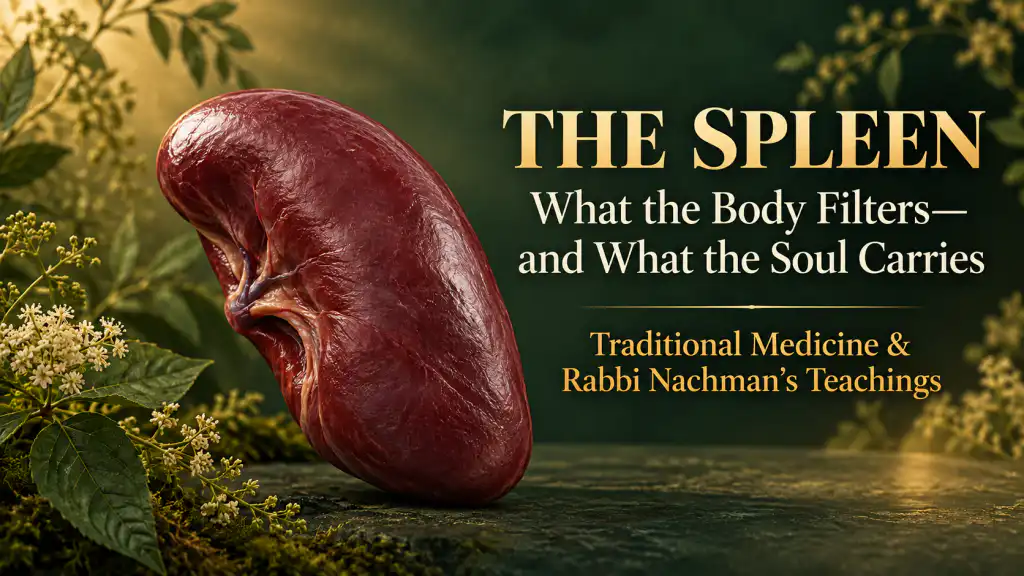
The spleen quietly handles what the body has already used, what has become worn out, and what no longer belongs in circulation. Traditional medicine saw something deeper in that work. The spleen was not viewed only as an organ dealing with the condition of the Blood, but as one connected to nourishment, heaviness, melancholy, repetitive thought, and the excesses we struggle to release.
That connection makes sense. Physical waste can burden the body, just as unprocessed thoughts, sadness, envy, fear, and constant striving can burden the mind and soul. The spleen teaches us that health depends not only on what we take in, but also on what we transform, what we use, and what we are willing to let go.
An Organ Surrounded by Blood
The spleen sits high on the left side of the abdomen, tucked beneath the ribs and behind the stomach. It is soft, reddish-purple, and surrounded by a fibrous outer covering. Its inner structure contains blood vessels, connective tissue, immune cells, red pulp, and white pulp, allowing it to remain in constant contact with the Blood.
It helps maintain blood volume, recovers usable material from worn-out blood cells, and filters impurities from circulation. This is not careless destruction. The spleen examines what has become damaged or exhausted, removes what should no longer remain, and helps return useful material to the body.
Anatomy of the Soul describes the spleen’s energy as being focused on the impurities and excesses found within the body. The more excess the system carries, the harder the spleen must work to separate what can still be used from what needs to be removed. This physical relationship with excess becomes the foundation for understanding the spleen’s much deeper traditional meaning.
Turning Food Into Something the Body Can Use
Traditional Chinese medicine teaches that the Stomach receives food, but the Spleen transforms and transports its nourishment. Eating healthy food is only the first step. The body must still extract what is valuable and turn it into Qi, Blood, warmth, strength, and usable energy.
This means a person can eat organic food, choose nutrient-dense ingredients, and still feel weak or depleted when the Spleen is struggling. The problem is not necessarily that the food lacks value. The body may be having difficulty receiving that value and sending it where it needs to go.
The Spleen is therefore closely connected with the muscles and limbs. When nourishment is transformed well, the muscles receive steady support and the body feels grounded. When the process weakens, a person may experience fatigue, heaviness, poor appetite, bloating, loose stools, weakness in the arms and legs, or the feeling that food is sitting instead of becoming energy.
The same system helps manage fluids. When fluids are transformed and moved properly, the body uses them where they are needed. When that movement becomes sluggish, traditional medicine says Dampness begins to accumulate. The result may be puffiness, mucus, swelling, sticky stools, mental fog, or a heavy feeling that sleep alone does not resolve. The body is not necessarily asking for more—it may be struggling with what it is already carrying.
And that is where the physical work of the spleen begins to mirror its emotional work.
Worry, Melancholy, and the Weight of What Remains
In traditional Chinese medicine, the Spleen is associated with thought, concentration, and the ability to mentally process information. It is especially affected by worry and overthinking. The mind takes in experiences much as the digestive system takes in food: it must work through them, draw out what is useful, and release what no longer needs to be held.
When a thought is processed, it can lead to understanding. When it is repeated constantly without resolution, it becomes mental weight. The mind keeps chewing on the same fear, conversation, decision, or possibility, consuming energy without producing clarity. This is why long periods of worry may be accompanied by changes in appetite, unsettled digestion, exhaustion, or brain fog.
Jewish teachings connect the spleen with a different but closely related emotional state: melancholy. In the older language of the four elements and bodily humors, the spleen was associated with black bile and described as cold and dry. It was connected with the element of earth—the lowest, heaviest, and densest of the four elements.
The Hebrew name given in Anatomy of the Soul is t’chol, while chol means sand. Sand and dust settle downward. They represent matter, heaviness, and inertia. In the same way, prolonged sadness can make a person feel as though everything inside has settled. Motivation weakens, the body becomes sluggish, and even ordinary responsibilities begin to feel physically heavy.
These traditions are not describing worry and melancholy as identical. Worry keeps the mind circling, while melancholy pulls the person downward. But both prevent movement. One traps energy in endless thought; the other weighs it down beneath sadness and inertia.
When Even Spirituality Becomes Too Heavy
Rebbe Nachman taught that excess is not limited to food, possessions, or physical matter. A person can also become excessive in the pursuit of spirituality.
Someone who constantly searches for stricter practices because they never feel confident in what they have already accomplished may become discouraged instead of uplifted. The desire to grow is good, but when spiritual devotion becomes dominated by fear, self-criticism, and the belief that nothing is ever enough, it can create the very sadness that blocks further growth.
The Torah says that we are to live through its commandments. They were given for life, not for a person to be crushed beneath them. Rebbe Nachman warned that excessive stringency in religious practice and in daily life can lead to depression because it removes the ability to recognize progress, receive joy, and appreciate what has already been done.
This is deeply connected to the work of the spleen. The spleen separates what is useful from what has become excess. Spiritually, we also need to distinguish between discipline that helps us grow and pressure that leaves us bitter, paralyzed, or convinced that we will never be good enough.
The Heaviness of Chasing More
The Jewish teaching goes even further by connecting the spleen with avarice, envy, and an obsessive pursuit of wealth. The issue is not wealth itself. Wealth can support family, charity, Torah learning, community, and important work in the world. The danger begins when accumulating more becomes a person’s entire purpose.
A person can spend a lifetime saying that the next amount of money, the next opportunity, or the next possession will finally provide peace. Yet every achievement only creates another level to chase. Instead of enjoying what has been provided, the person remains focused on what is still missing.
That state produces its own form of melancholy. There is constant waiting, comparing, complaining, and watching what other people possess. Envy then turns someone else’s blessing into a reason to feel personally deprived. The person may accumulate more physically while becoming emptier emotionally.
Anatomy of the Soul connects this pursuit with a lack of faith in the Creator’s ability to provide. That does not mean sitting back and refusing to work. We are still responsible for making an effort. The danger is believing that everything depends entirely upon us, then sacrificing our health, relationships, peace, and spiritual life in the chase.
Faith changes the weight of that effort. It allows a person to work without worshipping the outcome, to desire improvement without despising the present, and to receive material blessing without making it the source of identity.
“The Spleen Laughs”
After connecting the spleen with melancholy and the heaviness of material obsession, Jewish teaching gives us what may seem like a surprising statement: “The spleen laughs.”
This is not a contradiction. It points toward the remedy.
Rebbe Nachman taught that joy generates vitality. Sadness makes life contract; joy restores movement. This does not mean pretending that suffering does not exist or forcing a false smile over real pain. It means refusing to allow sadness to become the permanent ruler of the body and soul.
Sometimes joy comes naturally. At other times, it must be deliberately awakened through gratitude, music, movement, prayer, connection, laughter, generosity, or remembering the good that still exists. A person may need to create space for joy before they feel ready for it. According to Rebbe Nachman, that effort itself can begin loosening depression’s hold.
The spleen’s connection with laughter reveals something essential: heaviness is not meant to have the final word. The same organ associated with melancholy is also linked to the force that lifts a person out of it.
Nourishing the Spleen Without Creating More Burden
Because the Spleen must transform what we consume, traditional food support focuses on nourishment that is warm, simple, and easy for the body to use. Soups, stews, broths, cooked grains, and roasted or gently cooked vegetables provide building material without overwhelming digestion.
Sweet potatoes, carrots, pumpkin, squash, and parsnips carry the naturally sweet, grounding quality associated with the Earth element. Rice, oats, millet, well-prepared lentils, chickpeas, peas, and adzuki beans can provide steady nourishment. Eggs, fish, chicken, beef, and slow-cooked broths offer deeper support for Qi and Blood, while ginger, cinnamon, fennel, and cardamom can bring warmth and movement to sluggish digestion.
Natural sweetness can be grounding, but excessive refined sugar has a very different effect. Traditionally, it is understood to burden the Spleen and contribute to Dampness. Constant snacking, overeating, greasy meals, icy drinks, and relying heavily on cold raw foods may also create more work for a system that is already struggling to transform what it receives.
How we eat matters too. A nourishing meal eaten while rushing, arguing, working, or worrying is being received in an entirely different condition. Sitting down, chewing thoroughly, eating at reasonably consistent times, and allowing the mind to be present gives the body a better opportunity to turn food into strength.
Herbs such as astragalus, codonopsis, Chinese yam, ginger, licorice root, and atractylodes have traditionally been used to strengthen Spleen Qi, warm digestion, or move accumulated Dampness. The appropriate herb depends upon the person’s full pattern because weakness, coldness, heaviness, and stagnation do not all require the same approach.
What the Spleen Teaches Us
The spleen is continually working with what has become worn out, excessive, heavy, or no longer useful. Its lesson reaches far beyond digestion or Blood.
The body must filter physical excess. The mind must process thoughts without living inside them. The soul must distinguish healthy effort from destructive pressure, material provision from material obsession, and genuine spiritual growth from stringency that steals joy.
We were not created to hold everything forever. Some things are meant to nourish us. Some are meant to teach us. And some must be released before their weight begins to shape our health.
The Creator designed the body and soul to work together. When the body becomes overburdened, the mind feels it. When worry, sadness, jealousy, or relentless striving dominate the inner life, the body carries that weight as well. Supporting the spleen therefore means more than choosing certain foods. It means reducing excess, strengthening nourishment, making room for joy, and learning when enough is truly enough.
Supporting the Body’s Natural Renewal
The spleen is deeply involved with the Blood, immune activity, and the clearing and recycling of worn-out cells. Supporting the environment in which healthy cells are nourished, protected, and renewed also supports the systems the spleen depends upon to carry out its work.
The upcoming Lael Herbal Home Stem Cell Support Protocol is a whole-herb protocol designed to support the body’s natural renewal, resilience, and longevity. It is not a treatment for spleen disease. It provides whole-body support for the cellular environment, nourishment, and natural regenerative processes connected to organs involved in Blood and immune health.
Jewish teachings referenced in this article are drawn from the spleen section of Anatomy of the Soul, Chapter 11, which discusses teachings from Rebbe Nachman, Likutei Moharan, Tikkunei Zohar, Rabbi Nachman’s Wisdom, Yoma 85b, and Berakhot 61b.